
Corporate & Campus Training
Training built around your parts, on your machines, at your site.
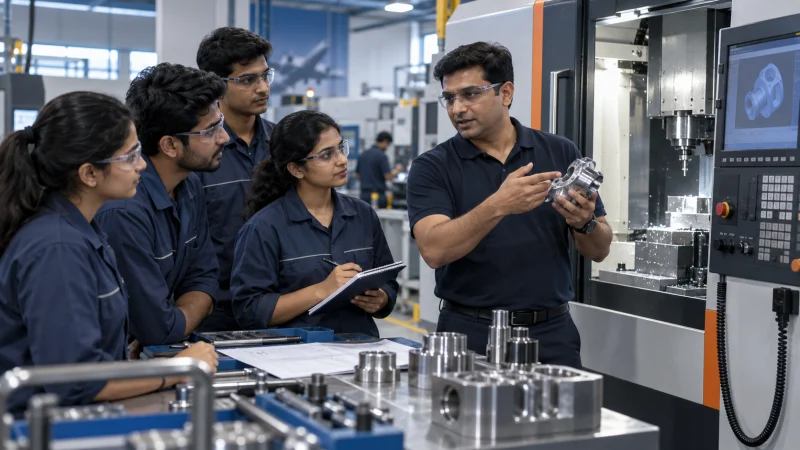
Generic training produces generic capability. When a company sends people on a public course, they come back able to programme the exercise from the course — not the part family sitting on your shop floor. On-site training removes that translation step entirely.
We start with an assessment rather than a syllabus. What can your team currently do, what does the work actually require, and where is the real gap? Sometimes the answer is not the course you thought you needed — a team struggling with scrap on five-axis work often has a process planning gap rather than a CAM gap, and training them harder on CAM would have changed nothing.
The syllabus is then built around your parts, your machines, your controllers and your post processors. Exercises are your components. The programmes your people write during the training are programmes you can actually use afterwards, which tends to make the return on the week fairly easy to see.
For colleges and skill development centres, the same approach applies with a different target: making graduates employable in the local manufacturing cluster. We work with faculty to align lab exercises with what regional employers actually hire for, and we are happy to say plainly when a lab's equipment or software situation is the real constraint.
Course at a glance
| Duration | Custom — typically 1 to 6 weeks |
|---|---|
| Mode | At your plant or campus |
| Who it is for | Manufacturing companies, engineering colleges, ITIs, skill development centres |
| Prerequisites | Defined by the batch. We assess before we design the syllabus. |
| Certificate | Issued on completion |
| Fees | Quoted per enquiry — varies by mode and batch |
Module by module
Sequenced so each module depends on the one before it. We adjust depth to the batch, but not the order.
| # | Module | What it covers |
|---|---|---|
| 01 | Skills assessment | Where your team is now, measured rather than assumed — including the gaps nobody has named out loud. |
| 02 | Needs analysis | What the work genuinely requires, mapped against the assessment to find the real gap. |
| 03 | Syllabus design | A programme built around your parts, machines, controllers and post processors, agreed before we start. |
| 04 | Delivery | On-site instruction at your plant or campus, in batch sizes that keep everyone hands-on. |
| 05 | Applied project | Your team works on your components, producing programmes and documentation you keep. |
| 06 | Post-assessment | Measured against the same baseline, so the improvement is a number rather than a feeling. |
| 07 | Handover pack | Course material, exercise files and reference documentation left with your team. |
| 08 | Follow-up support | A defined support window afterwards, because the questions arrive once people start using it. |
What you will be able to do
Stated as capabilities, not topics covered. If you finish and cannot do these, the course has not worked.
- A team measurably more capable on the specific work your business actually does.
- Programmes and documentation produced during training that you can use in production.
- A written skills baseline before and after, useful for appraisal and for planning the next step.
- Course material and exercise files retained in-house for onboarding future joiners.
- For colleges: lab exercises aligned to what regional employers are actually hiring for.
- An honest report on any capability gaps that training alone will not close.
Certification & placement support
A completion certificate recording your modules and your assessed project — plus the part of it that actually matters: interview preparation, CV guidance aimed at manufacturing employers, a portfolio of work you can open and explain, and referrals into our industry network when we think you are ready.
We do not guarantee placement, and this is a Teklogic certificate rather than a software vendor's certification. What we can do is make sure you walk in able to demonstrate something real.
Register for this courseBefore you enrol
Eight to twelve keeps everyone hands-on and lets the trainer reach each person during an exercise. We can run up to about twenty where the content is more classroom-weighted, and below five it is usually more economical to send people to a public batch — we will say so rather than quote you for something that does not make sense.
That is exactly the point of on-site delivery. Send us your machine list, controller types and post processors during the needs analysis and the syllabus is built around them. Your team learns on the kit they use on Monday morning.
Yes — faculty development, lab-aligned student programmes and industry-readiness modules. We will also tell you honestly if the lab's software or equipment situation is the binding constraint, because in that case a training programme is treating the symptom.
Send us a drawing. We’ll send back a plan.
Share a 2D print, a STEP file or a scope note. You get a written response with feasibility, approach and an indicative timeline — no obligation, and your data stays yours.