2D to 3D Modelling
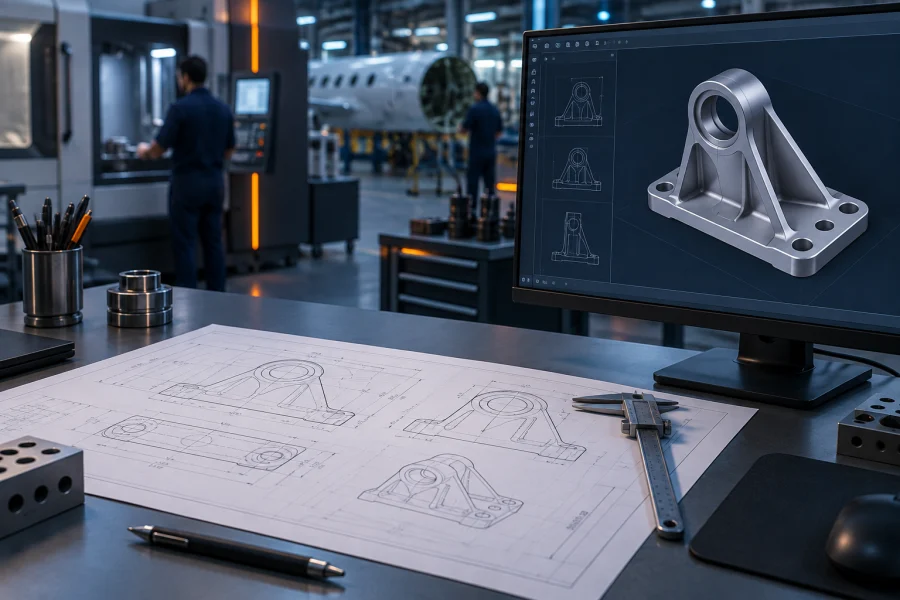
A drawing is a description. A model is something you can machine.
Most shops still have a drawer — physical or digital — full of parts that only exist as 2D prints. Some are decades old, some are scanned at an angle, some contradict themselves. Until those become models, they cannot be programmed, simulated or quoted properly.
What we actually do
We rebuild the part as a native, fully-constrained solid model in your CAD platform — not a dumb imported body. That means the model can be edited, revised and used as a genuine manufacturing master rather than a one-time picture.
Geometric dimensioning and tolerancing is carried across, not discarded. Datum references, position tolerances, profile callouts and surface finish requirements all travel with the model, so the downstream programming and inspection have the same source of truth the designer intended.
Where the drawing is incomplete, ambiguous or self-contradictory — and old drawings very often are — we do not quietly pick an interpretation. We produce a written query list with our recommended reading of each item, and wait for your sign-off before it becomes geometry.
What is included
Native parametric models
Built with a clean, editable feature tree in your own CAD platform, to your own modelling standards.
GD&T carried across
Datums, position, profile and surface finish preserved as model annotation or an associated drawing.
Written query register
Every ambiguity in the source print listed with our recommended interpretation, resolved before modelling completes.
Assembly reconstruction
Multi-part assemblies rebuilt with mates, clearances and interference checks, not just loose bodies.
Model repair & healing
Broken imported geometry, failed surfaces and non-manifold bodies fixed into watertight solids.
Manufacturing-ready output
Models built the way a machinist needs them — correct stock datum, sensible origin, no hidden slivers.
How we approach it
The same sequence on every job, so you always know where your part is.
Assess the source
We review what you have — PDF, DWG, TIFF, scan or photograph — and tell you honestly what is legible and what is not before quoting.
Raise queries
Ambiguities, missing dimensions and contradictions go into a written register with our recommended reading of each.
Model
Built as a native, constrained solid with a clean feature tree and a machinist-sensible origin and datum scheme.
Verify
Mass properties, geometry checks and a dimension-by-dimension comparison against the source print.
Hand over
Native file, neutral formats, regenerated drawing, query register and QA report — all yours.
What you receive
Every deliverable is yours outright — native files included. No lock-in, no dependency on us to make the next revision.
| Deliverable | Detail |
|---|---|
| Native CAD file | Fully-constrained part or assembly in your platform's native format, feature tree intact |
| Neutral formats | STEP AP214/AP242 and Parasolid for downstream use, plus STL where required |
| 2D drawing | Regenerated and dimensioned drawing where the original is unusable, to your title block |
| Query register | Signed-off list of every ambiguity found in the source and how it was resolved |
| Model QA report | Geometry check, mass properties and a documented comparison against the source print |
Common questions
Send it anyway. We work from scans, faxes, blueprints and phone photographs routinely. We will tell you upfront which dimensions are legible and which will need to go into the query register — you get that assessment before you commit to anything.
Yes, working from your measurements or from scan data. We will need a clear brief on which features are functional and which are incidental, since a scan of a used part records wear as though it were design intent.
Only for as long as the project needs, under NDA and in segregated storage. On request we return everything and delete our copies at project close.
Send us a drawing. We’ll send back a plan.
Share a 2D print, a STEP file or a scope note. You get a written response with feasibility, approach and an indicative timeline — no obligation, and your data stays yours.