CNC / NC Programming
Toolpaths written for the cut, not just the shape.
Any CAM system will generate a path that reaches the geometry. Whether that path keeps the cutter in a sensible engagement, respects the tool's stick-out, evacuates chips and leaves the machine somewhere safe is a different question — and it is the one that decides your tool life and your surface finish.
What we actually do
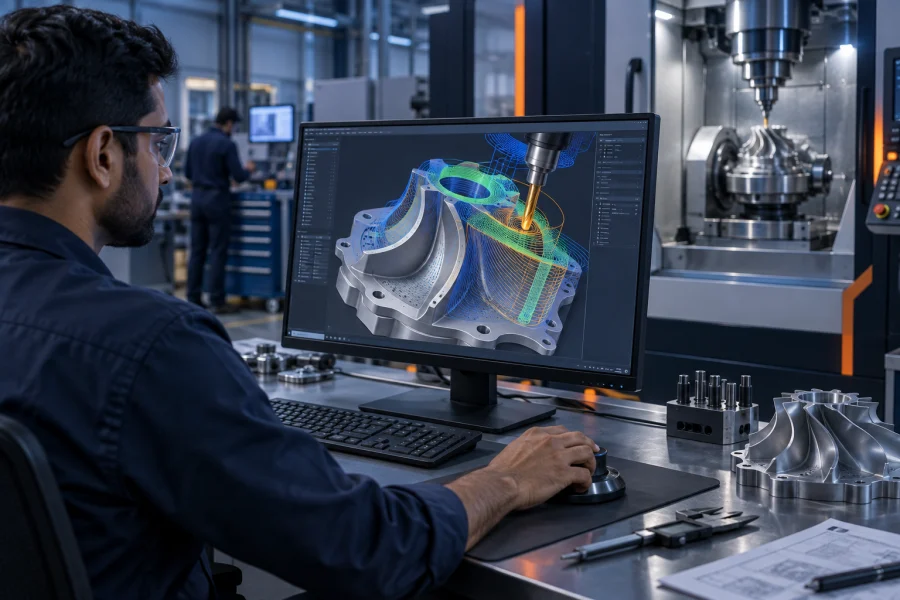
We programme across the full range: 2.5D and 3-axis milling, 3+2 positional, full 5-axis simultaneous, turning, and mill-turn on multi-tasking machines with driven tools and sub-spindles. The strategy is chosen for the material and the machine, not for whichever cycle the CAM system defaults to.
Cutting parameters are engineered. Feeds, speeds, engagement angles and stepovers come from the material, the tool geometry and the actual rigidity of the setup — which means titanium and Inconel get programmed like titanium and Inconel, not like aluminium with the feed turned down.
Output is posted for your specific controller and formatted to your shop's conventions: your block numbering, your tool-change routine, your safety blocks, your coolant habits. Operators should not have to translate our output into their normal way of working.
What is included
3-axis & 2.5D milling
Prismatic parts, pockets, faces and drilling with efficient roughing and controlled finishing passes.
3+2 and 5-axis simultaneous
Impellers, blisks, complex aerostructures and deep-access features with tilted and continuous strategies.
Turning & mill-turn
Multi-tasking machines with driven tools, sub-spindle transfers and synchronised channel programming.
High-efficiency roughing
Trochoidal and adaptive strategies that hold constant engagement and multiply tool life in hard materials.
Hard milling & finishing
Surface-finish-driven strategies for hardened tool steel, cavities and cores.
Complete setup packages
Tool lists with holders and stick-out, offset tables, setup sheets and operator notes.
How we approach it
The same sequence on every job, so you always know where your part is.
Confirm the inputs
Model, process plan, fixture, machine, controller, tooling inventory and your post processor.
Strategy selection
Roughing and finishing approach chosen for the material, the feature and the rigidity of the setup.
Programme
Toolpaths built with engineered cutting parameters and sensible, safe linking moves.
Post and edit
Output posted to your controller and formatted to your shop's conventions.
Verify and release
Full machine simulation, then the complete package with tool list, setup sheet and report.
What you receive
Every deliverable is yours outright — native files included. No lock-in, no dependency on us to make the next revision.
| Deliverable | Detail |
|---|---|
| Posted G-code | Ready for your controller, formatted to your shop standards and verified before release |
| CAM project file | The full native project, so your team can edit and revise it independently |
| Tool list | Every tool with holder, assembly, stick-out, and recommended feeds and speeds |
| Setup sheet | Datum location, clamping detail, work offsets and a loading illustration per operation |
| Simulation report | Evidence that the programme has been proven against the machine's real kinematics |
Common questions
Fanuc, Siemens 840D, Heidenhain, Mazak, Okuma, Haas and Mitsubishi are routine. Send your existing post processor and a sample of known-good G-code from the machine and we will match your conventions exactly. If your post needs work, we can develop or tune it.
Yes. We can work in your environment via remote access where your IT policy allows it, which keeps everything inside your systems. Otherwise we work on our own seats and deliver both the posted code and the native project file.
Then start upstream. Programming against an undefined datum scheme or an imaginary fixture produces a programme that has to be redone. We can take the job from process planning onwards, or programme to your existing plan if you have one.
Send us a drawing. We’ll send back a plan.
Share a 2D print, a STEP file or a scope note. You get a written response with feasibility, approach and an indicative timeline — no obligation, and your data stays yours.