
Manufacturing Process Planning
Cycle time is decided here, not at the machine.
By the time a programme reaches the control, most of its cost is already fixed. The operation sequence, the datum scheme, the stock size and which machine the part goes on together decide how many setups you pay for and how much material you turn into swarf.
What we actually do
We work out the shortest defensible route from raw stock to finished part on the machines you actually own. That means real capacity planning — spindle power, travels, tool capacity, table load and bar capability — not a theoretical sequence that assumes an ideal machine.
The datum and locating strategy comes first, because it determines everything after it. We work the tolerance stack backwards from the inspection requirement to make sure each operation can actually hold what the drawing demands, and flag it early when it cannot.
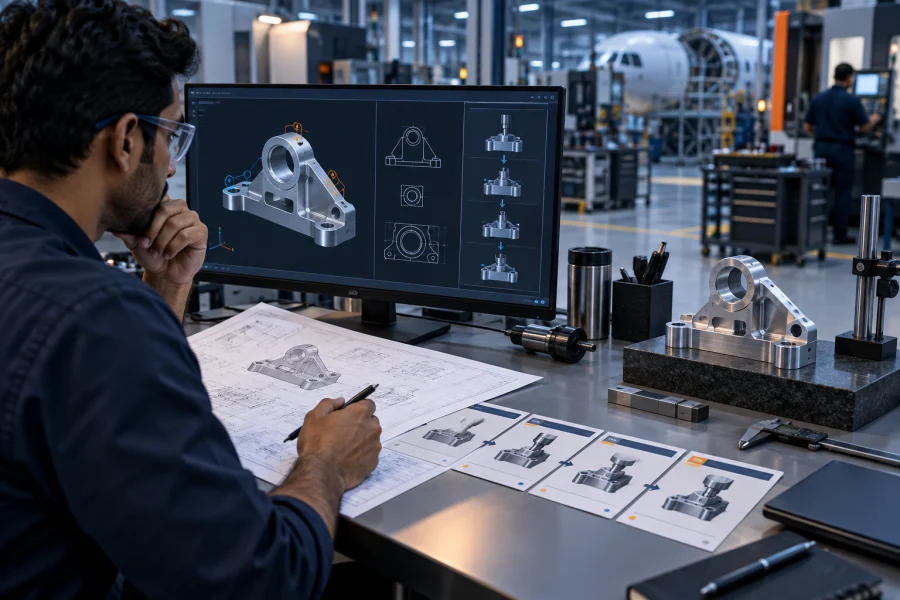
The output is a routing package your planners and operators can work from directly: operation sequence, machine allocation, stock definition, workholding concept per operation, estimated cycle time per op and the in-process dimensions that matter.
What is included
Operation sequencing
The minimum number of setups that can still hold the tolerance stack — with the reasoning written down.
Datum & locating strategy
Worked backwards from the inspection requirement so each op can hold what the drawing asks for.
Stock & material planning
Bar, billet, casting or forging sizing with machining allowance justified rather than guessed.
Machine allocation
Matched to your real capacity — travels, power, tool count, table load and bar capability.
Cycle time estimates
Per operation, built from real feeds and speeds for the material and tooling, not a flat multiplier.
Routing documentation
Operation sheets, process flow diagrams and in-process dimensional requirements.
How we approach it
The same sequence on every job, so you always know where your part is.
Read the part properly
Tolerances, datums, material condition, batch size, inspection method and what the part has to do in service.
Audit the capacity
Your machine list, tooling inventory, workholding on hand and the realistic constraints of each.
Build the route
Operation sequence and datum strategy developed together, since neither is meaningful without the other.
Stress the stack
Tolerance analysis across the sequence to confirm every feature is achievable as routed.
Document and review
Route sheets, flow diagram and risk register issued for your sign-off before any programming begins.
What you receive
Every deliverable is yours outright — native files included. No lock-in, no dependency on us to make the next revision.
| Deliverable | Detail |
|---|---|
| Process route sheet | Operation-by-operation sequence with machine, workholding, tooling class and estimated time |
| Datum strategy note | Locating scheme per operation with the tolerance stack analysis behind it |
| Stock specification | Material form, size and allowance with the justification for each dimension |
| Process flow diagram | Visual routing suitable for inclusion in an APQP or PPAP submission |
| Risk register | Features flagged as difficult, plus the mitigations we recommend for each |
Common questions
Yes — process audits are some of the most valuable work we do. We take your existing route, model the tolerance stack and the cycle time, and report where setups can be removed, where the datum scheme is fighting you, and where you are at genuine risk. You get a findings report you can act on independently.
Not necessarily. A machine list with travels and power ratings, your tooling inventory and photographs of typical workholding usually cover it. For complex multi-machine routing or a new production line, a site visit is worth the day.
Yes, and it is a good time to ask. We can route the part family against candidate machines and show you the cycle time and setup count implications of each — which often changes the purchase decision.
Send us a drawing. We’ll send back a plan.
Share a 2D print, a STEP file or a scope note. You get a written response with feasibility, approach and an indicative timeline — no obligation, and your data stays yours.