- Home
- Training
Training taught by the engineers who do the work.
India does not have a shortage of people who can drive a CAD package. It has a shortage of people who understand what happens when the cutter meets the metal. Everything we teach is aimed squarely at that gap.
The syllabus comes off the shop floor, not out of a manual
Most CAD/CAM courses teach you the software's menus. You finish able to reproduce the exercise in the book and unable to programme a real part.
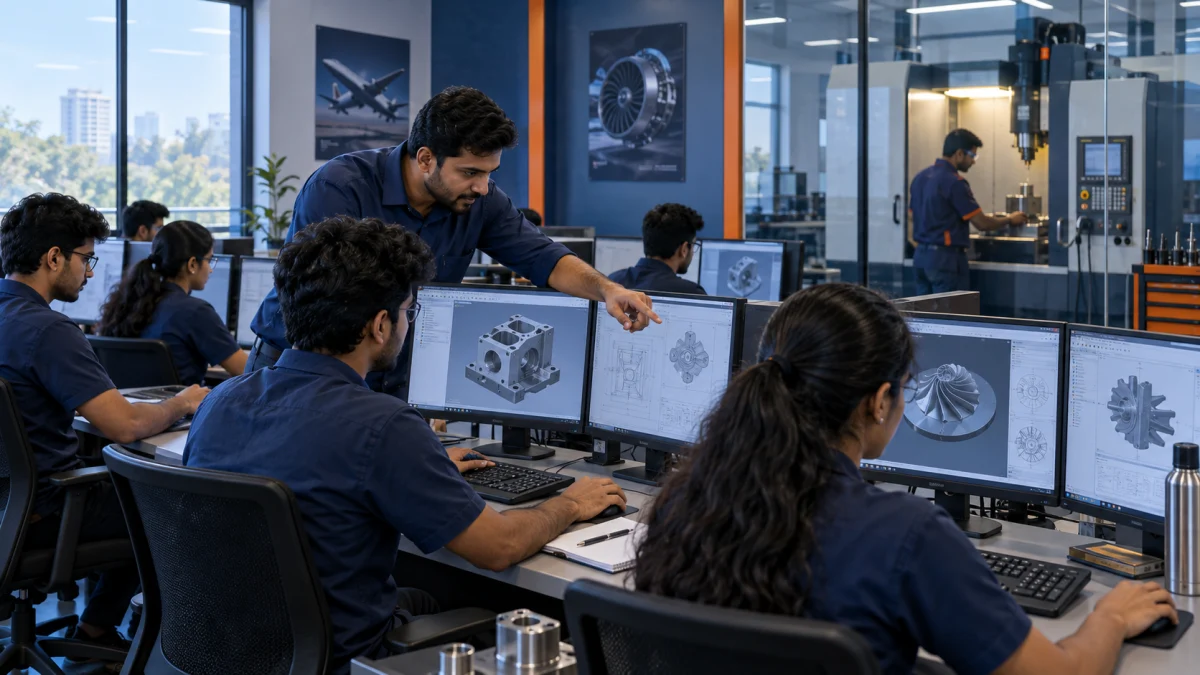
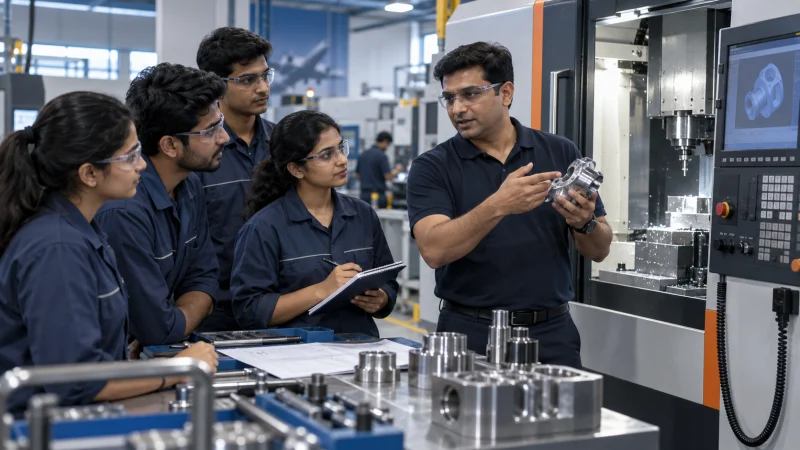
Our trainers are the same engineers who deliver client projects — process planning, fixture design and five-axis programming, every week. What they teach on Monday is what they were doing on Friday. The exercises are real part families with real tolerance problems, and if a technique is not good enough for a paying client's part, it does not go into the syllabus.
That has a consequence worth being honest about: our courses are harder than the average. You will be asked why a datum was chosen, not just how to click the datum button. People who want a certificate for the wall find that frustrating. People who want a job find it is the point.
- Every learner programmes a real part end to end — model, plan, fixture concept, toolpath, post and simulate.
- Small batches, so nobody spends the session watching over someone else's shoulder.
- Machine-side context throughout — setup, offsets, tool wear and what the operator has to live with.
- Portfolio, not just a certificate — you leave with programmes and documentation you can show an interviewer.
capped deliberately
at the workstation
by every learner
or at your plant
Three tracks, one destination
Whether you are a fresh graduate, a machine operator moving up, or a design engineer who needs to understand machinability, there is a route in.
 Core track
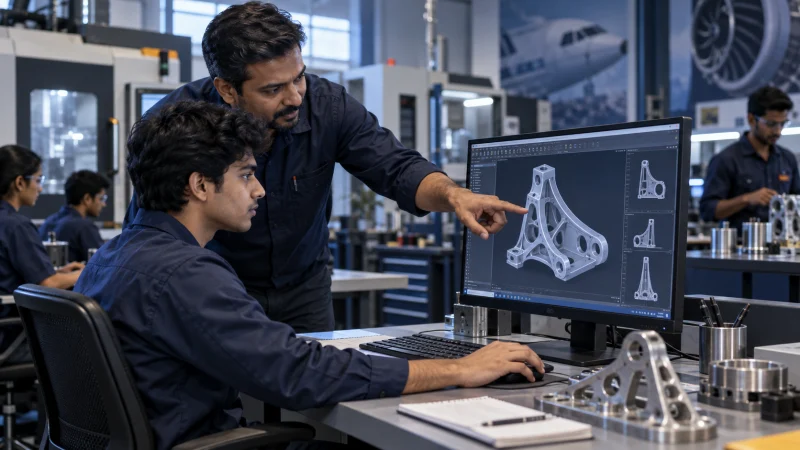
CAD / CAM Training
Modelling through to posted, simulated G-code on industry-standard CAD and CAM platforms. The exact software for your batch is confirmed before you enrol.
 Machine track
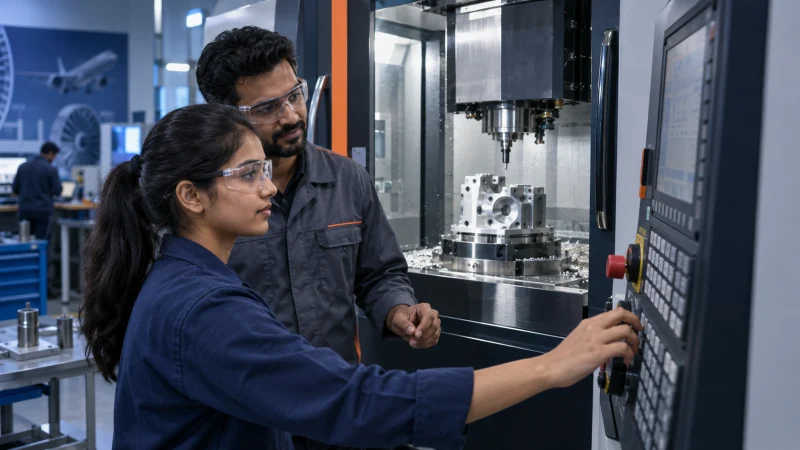
CNC Programming & Operator
Manual G-code and M-code, canned cycles, machine setup, work offsets, tool offsets, probing basics and safe operation on mill and lathe.
 On-site
Corporate & Campus
Batch upskilling delivered at your plant or college, built around your part families, your machines and your controllers rather than generic exercises.
Four people walk into our classroom
Diploma & engineering graduates
Mechanical, production, aeronautical and mechatronics graduates who need employable skills the day they walk into an interview — not theory they cannot demonstrate.
Operators moving into programming
You already know what the machine sounds like when it is unhappy. That is a real advantage. We add the CAM and the process thinking on top of it.
Design engineers
If your parts keep coming back with manufacturability queries, a fortnight understanding how they get cut will change how you design permanently.
Companies with a skills gap
New machine, new sector, new customer requirement — we build the batch around the actual capability you are missing and run it at your site.
Three ways to attend
| Mode | Where | Best for | Notes |
|---|---|---|---|
| Classroom | Vidyaranyapura, Bengaluru | Freshers and career changers | Weekday and weekend batches; one workstation per learner |
| Live online | Remote, instructor-led | Working professionals | Live sessions with recordings; software access guidance provided |
| On-site | Your plant or campus | Corporate and college batches | Syllabus built around your parts, machines and controllers |
Software, controller and machine tool names used on this site are the trademarks of their respective owners and appear only to describe the environments Teklogic works in. Teklogic is an independent engineering and training provider, and is not affiliated with, endorsed by, certified by, or an authorised reseller or training partner of any software vendor. Certificates issued on completion are Teklogic’s own and are not a software vendor certification.
Before you enrol
No, and we would be careful with anyone who does. What we do provide is placement support: interview preparation, a portfolio of real programmed parts to show, CV guidance aimed at manufacturing employers, and referrals into our own industry network when we think you are ready. The training is designed to make you employable; the hiring decision belongs to the employer.
For the CNC Programming and Operator track, yes — it starts from first principles. For the CAD/CAM track you will get much more out of it with a mechanical or production engineering background, because we assume you can read an engineering drawing. If you are unsure, tell us your background in the enquiry and we will tell you honestly which track fits.
Machine-side sessions are arranged through partner shop floors and depend on the batch and the course. Programming, simulation and setup planning are always hands-on at a workstation. We will tell you exactly what machine access your batch includes before you pay — we would rather set the expectation correctly than have you find out on week three.
For classroom batches, workstations are provided. For live online, we guide you to legitimate student or trial licences for the platform your track uses. We do not distribute software and we will not point you at pirated copies — beyond the legal issue, learning on a cracked seat with broken post processors teaches you the wrong things.
Yes, and it is usually the better option once you have five or more people. We build the syllabus around your part families, your machines and your controllers, run it at your site, and finish with your team able to work on your actual jobs rather than on our exercises. See the corporate programme for detail.
Send us a drawing. We’ll send back a plan.
Share a 2D print, a STEP file or a scope note. You get a written response with feasibility, approach and an indicative timeline — no obligation, and your data stays yours.